Phannie

Phannie
Photo taken near Monument Valley, Utah

Wednesday, June 21, 2023

Phannie Needs a Little Extra Attention, So Plans Change

 At Tom Sawyer RV Park, West Memphis, Arkansas...


You may recall from a previous post that I had made a miscalculation about the need to make an appointment at Bay Diesel for Phannie's annual checkup. We spent quite a few, um, less-than-productive days awaiting our turn, and then the day came. The servicing took only a couple of hours, but we learned from the tech that some more work would be needed, and that would involve the ordering of parts.

Ordering parts for a "classic" coach like Phannie is not always easy, and it certainly doesn't happen quickly. It seems the old girl needs attention mostly to the suspension system, something that is completely understandable after 16 years and 125,000 miles. The need, it appears, is for new airbags, repair to a leak in the air line, new shocks and, oh, by the way, new engine hoses. The old gal is still quite drivable, and I don't notice any difference in her handling, but I really had some misgivings about a long trip to Colorado this summer without updating things that could cause a breakdown in the middle of nowhere. 

So, I had quite a bit of back-and-forth with Teresa at Bay Diesel regarding when Phannie may return to have all this done. "Well," she said, "We're gonna have to order some parts, and we don't know how long it will take to get them here for a coach like yours."

I thought her choice of words was nicely done--typical of ladies of the South. If we had been somewhere in Yankee territory, I would probably have heard something like, "It's gonna take us a while to comb through junkyards to find what you need for this derelict coach of yours."

Well, some may think she is a derelict, but she has been lovingly cared for and has had many new upgrades over the years. Her hulky Caterpillar diesel engine, the same monster that runs hundreds of thousands of pieces of construction equipment all over the world, has never had a hiccup, and it has not needed a drop of DEF. Studies have shown that it should easily reach 500,000 miles before any major repair is needed; that will certainly outlast us! Phannie is solidly built from when almost every Tiffin owner will admit were the "good" years. Trade her off? Unthinkable.

Teresa and I settled on July 24 as the day of the work. "July 24?" I was aghast that we would have to hang around for a month in a town that was too small even for a WalMart. Red Bay doesn't even have a Dairy Queen, for goodness' sake! 

During our downtime awaiting her service visit, I had Phannie's exterior lighting upgraded to something a little brighter when we need it. I'm pretty happy with the result:


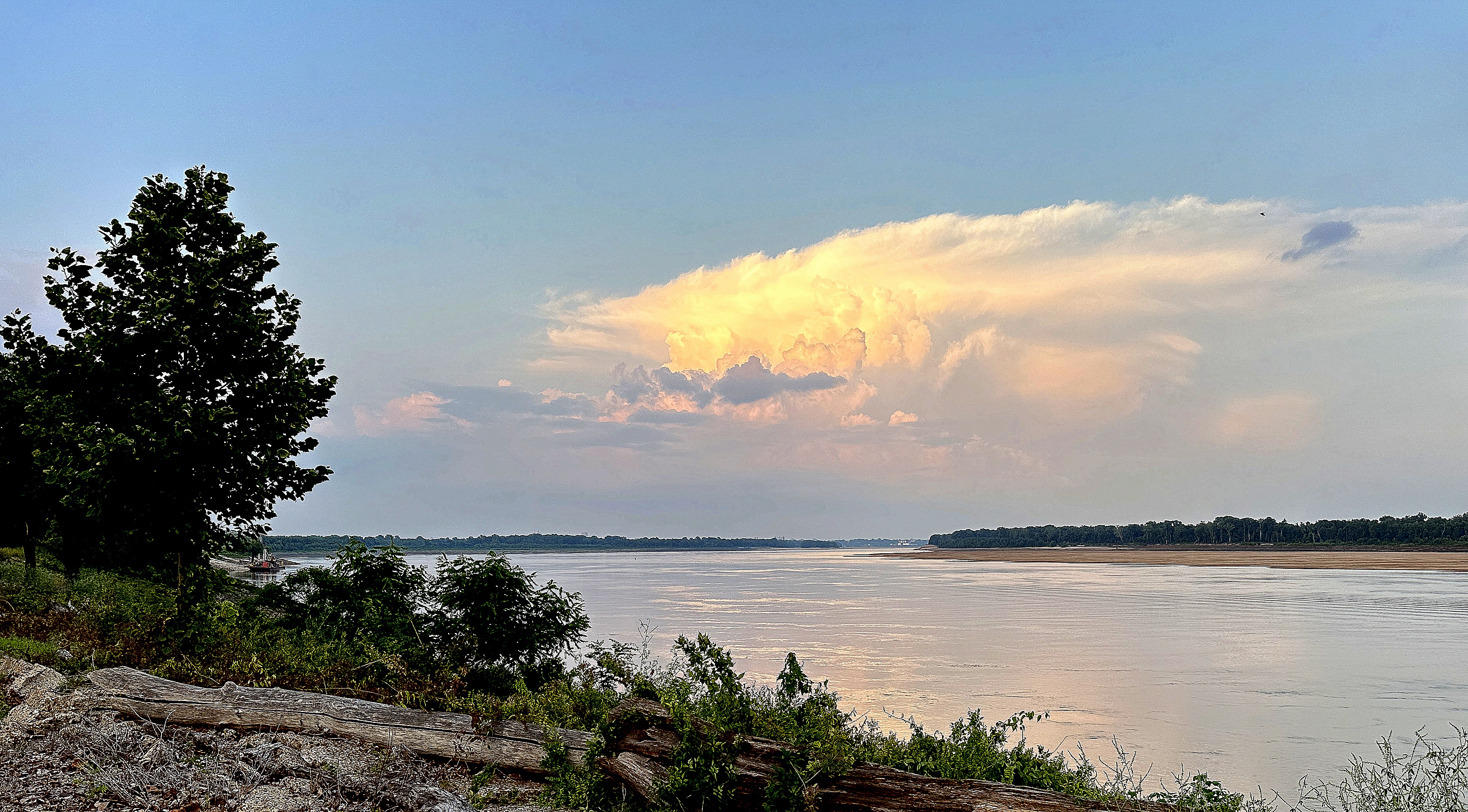
Since we had more than a month to kill before July 24, we decided to drive over to Memphis and attend the annual gospel quartet show. Having been a gospel pianist all my life, I really enjoy these. We always park at the Tom Sawyer campground by the Mississippi River. It's always fun to watch the river traffic go by:


The river is very low right now, as you can tell from the narrowness at this point. This places the navigable channel very close to our campground, which is even better for viewing the river traffic.

Walking near the water, I spotted these old logs that had been washed downriver perhaps decades ago, undoubtedly uprooted by a flood from who-knows-where:


There is so much history associated with this mighty river, it is easy to get lost in thought about its past and, indeed, its present. I could almost hear the wonderful old song, "Old Man River" that I play often when I do show tunes on the piano:

After attending the quartet show, we'll leave Memphis and spend a couple of weeks in Branson with old friends Larry and Carolyn and their family. That will be a fun experience and a pleasant way to pass the time until our return to Red Bay. 

After that, we will finally make our way to Colorado and the cool mountain air. Fortunately, the temperature has been unusually comfortable in this area since we left Texas. I hope it stays that way for another month. I looked at the temperature in Hondo today, and it was 104 with a heat index of 117; that's why most of the park empties out in the summertime. We think of our friends who have to stay there in the summer and thank Mr. Carrier for inventing air conditioning.

Thanks to all for hanging on as we take the curves in our trip plans, but that's the nice thing about being retired--who cares?

 Thank you, Lord, for this wonderful life; please forgive me if I don't appreciate it as I should every day.


We don't stop playing because we get old; we get old because we stop playing. 
 ---George Bernard Shaw

"I get up every morning, and I just don't let the old man in." ---Clint Eastwood


Monday, June 12, 2023

A "War" Story From Long Ago

 At Downtown RV Park, Red Bay, Alabama...

Since we are in a bit of a waiting period here in Red Bay, I thought it would be a good time to re-publish the monthly column I write for my hometown (Nacogdoches, Texas) advertising paper, Around The Town. Recent columns I've written have described the operation of flights in smaller airplanes carrying U. S. Mail across the U. S. at night. This was about a five-year experiment by the U.S.P.S. some 50 years ago and, in the area of east Texas where I grew up, I became the lone pilot performing those flights for most of the program's duration. It doesn't seem like that long ago, of course, but few of the citizens knew about them back then--and especially now that a half-century has passed. There will be one more column on the subject after this one, and I hope you find these little lagniappes  interesting.


Flying the Mail—It Wasn’t all Roses


It was a winter night, and a thick cloud cover lay over most of eastern Texas. I couldn’t reach the top of the clouds to find clear sky, and the cloud bases were only a few hundred feet from the ground. So, it was one of those nights--flying by instruments for the entire trip after leaving Dallas. I was barely able to make a successful NDB (a now-primitive Non-Directional Beacon) approach into Palestine and, after unloading, I was off again, back into the clouds seconds after raising the landing gear after takeoff. After leveling at a low cruising altitude, and the big Pratt and Whitney radial engines were humming smoothly, I noticed a wisp of smoke seeping out from behind the instrument panel in front of me. After a few minutes, the smoke became thicker, and the attitude deviation indicator (a pilot’s primary flight situation instrument because it mimics the position of the airplane if there were no clouds) in front of me slowly began to skew, indicating the airplane was beginning to bank when I had not moved the controls. I glanced over to the right side of the panel to compare this with the copilot’s ADI, which showed the airplane to be in normal, straight-and-level flight. I knew I had a problem, but I didn’t know if it was limited to the ADI. Now, an on-board fire is the last thing a pilot wants in an airplane, so I began tripping circuit breakers to any electrical instrument on the left side of the panel, and the smoke soon stopped. (I can’t remember what was found to be the problem—probably the ADI itself.)

Fortunately, almost everything critical on an airplane is duplicated in case of failure. Had there not been a duplicate set of operative instruments on the right side of the panel, I would have been a goner. Why? Because without some kind of visual reference to an airplane’s attitude (position in the air), there is nothing to counteract the brain’s false sensations of what the airplane is doing. There are several sensory elements, located mostly in the ear canal, that always sense false cues about the position of the airplane if a pilot’s outside vision is lost. Almost every change in the airplane’s position—even its acceleration or deceleration—sends false signals that eventually and inevitably end in loss of control of the airplane if there is no countering visual reference. The technical name for this is spatial disorientation. It is for that reason that special training and a special certificate is required for pilots to fly solely by reference to instruments.  I can still hear the instructors’ admonitions when I was obtaining an instrument rating: “Trust the instruments, trust the instruments, no matter what your brain is telling you.”

There have been a number of fatal airplane accidents attributed to spatial disorientation, some involving the loss of famous people, such as Buddy Holly in 1959, Patsy Cline in 1963 and John F. Kennedy, Jr. in 1999, among others.

Since my side of the instrument panel was disabled, I was left with the copilot’s instruments to fly the airplane, except I was in the wrong seat. (By the way, there is no requirement for a copilot on the Beech 18 and there was none on board that night.) I quickly unbuckled and moved over to the right seat, where I could fly more effectively what I knew would be another instrument approach with low clouds at the Lufkin airport. The only problem was a little feeling of awkwardness in operating the aircraft from the right seat. I had never flown the Beech 18 from the copilot’s seat and, while I wasn’t concerned about it, things certainly felt different. All the controls were now operated by opposite hands from usual. The airplane had no autopilot, so I just had to ignore the different perspective and keep flying.  

Since you’re reading this, I obviously arrived safely after the approach into Lufkin, awkward as it was, but it was a bit tense that night—just so you won’t get the idea that everything always went smoothly for a mail pilot.

Today’s pilots are probably shaking their heads at the primitive nature of the aircraft instrumentation we were using 50 years ago. Today’s avionics are, by comparison, stunning in their technology, capability and redundancy.  

I have one more mail-flying “war story” to tell you next month, then we’ll move on to something else.

The photo below is that of a Beech 18 instrument panel. The ADI is the round blue instrument just above the yoke (steering wheel for non-pilots). See how it mimics the airplane relative to the ground and sky?


 Thank you, Lord, for this wonderful life; please forgive me if I don't appreciate it as I should every day.


We don't stop playing because we get old; we get old because we stop playing. 
 ---George Bernard Shaw

"I get up every morning, and I just don't let the old man in." ---Clint Eastwood


Friday, June 2, 2023

Red Bay Again and an Interesting Side Trip

 At Downtown RV Park, Red Bay, Alabama

It has been quite a while since we've been to Red Bay for Phannie's annual service--especially since Colorado is sort of the other direction from Texas. In the previous post, I explained about our paint touch-up combined with a visit with friends in Searcy, Arkansas that placed us within a few hours of Red Bay, and we don't know of any better place for diesel service than Bay Diesel there.

Red Bay hasn't changed much. It's still a sleepy little town, lost in the last century--a real plus, in my mind. Nothing is "woke" here; I doubt if they even know what that is. Restaurants come and go. One has changed to a barbeque joint, and another has changed from Chinese to Mexican food; both are mediocre, unfortunately.

Because of the vast migration of Tiffin motorhomes through their birthplace here, repairs often take a while, even though there is a myriad of non-Tiffin shops to do the work the factory turns down once a coach attains five years of age. We've learned to make appointments and just wait our turn. This is the first time, however, that we weren't able to get an appointment with Bay Diesel within a few days of our arrival. "Two weeks," they said! Alas, they have been discovered. It's okay, though. We had a couple of other things to be done and we really prefer now to go places and say awhile. But we've already written about that.

Luckily, we caught up with Walt and Lanie from our home park in Hondo. They were finishing up some factory work and some paint touch-up, so we were able to visit with them for a while. Walt was kind enough to help me install the new pole that will lift our Starlink antenna up above Phannie's roof:


It was great to toss our backup hotspot in the drawer and get back to Starlink's blazing internet. Thank you, Walt, for your help.

In a couple of days, we bade them goodbye and decided to take a day trip to Corinth, Mississippi--about an hour away and a place we had never visited. Corinth is a good-sized town, nestled in rolling hills and, not known to us, the site of a crucial battle in the Civil War. Back in that time, Corinth was a strategic railroad crossroads between north and south and east and west. The crossing point is still there:


Corinth was originally held by 25,000 Confederate troops under the command of General P.T.T. Beauregard. The Union wanted badly this strategic rail center and lay siege to it for a month in the spring of 1862. Commanding the much larger Union army was Major General Henry Halleck, who said that Corinth was of equal importance as Richmond, the Confederate capital, and he successfully took the city on May 30, 1862. The result was that the Confederate army no longer had access to the rail line into western Tennessee, thusly limiting any successful occupation in that direction. 

After the Union victory, no fewer than six Union generals visited or headquartered at Corinth, including Ulysses S. Grant, whose control of the lower Mississippi River basin was thusly assured for the rest of the war.

This is the Mask House, near downtown Corinth, which served as the headquarters of several Union generals. It has been lovingly restored and donated to the city of Corinth:


The site of General U. S. Grant's headquarters was just south of the Mask house; it is now occupied by the Corinth City Hall:


On our way into town, we stopped at Abe's Diner, a near-junkyard of memorabilia of the last half-century or longer:


We parked in front of a non-functioning parking meter and a hundred-year old gasoline pump. The vastness of the memorabilia, inside and outside, was mind-boggling.

We were seated by Pat, the current owner, on a couple of barstools at the counter; there were no chairs, tables or booths in the tiny place. Pat, a rotund and delightfully pleasant older man, was stationed at the takeout window with an open cash drawer crammed with money that could easily have been purloined by anyone within reach. But such things apparently don't happen in this place. I can guarantee that at least one of the stools was occupied by a patron with a firearm.

Cooking at the griddle was Lynn, Abe's grandson, and his mother, who was dishing up freshly-cut and fried French fries:


Hanging from the ceiling were dozens of license plates, and surrounding the menu were all kinds of currency, and even a Fedex truck hanging by a string.

Pat, wearing a blue apron like that of his wife and son, walked over to us, noticing that Sandy and I had ordered only a hamburger each and no French fries. He seemed distressed by this, pointing to a potato slicer in the corner and telling us the fries being loaded onto most of the other customers' plates were cut "right there this very morning." The temptation was great, but we politely declined, trying to stay as much as we could within the diet regimen Sandy and I have been painfully enduring for more than a year. Pat's face dropped, but he said he understood. Now, I actually regret that we didn't at least split an order of the fries.

Afterward, we drove around town for a while. The museum was closed, but we saw some charming and well-kept homes like this one:


We were out of most everything, it seemed, so we made a Wal-Mart stop that took a couple of hours and over four hundred bucks of stuff--almost none of which was food. This would be a good place to rant about politics, but I have learned that it is fruitless to do so in this blog. There are just some things I will never understand.

Corinth is the county seat of Alcorn county, and I snapped a photo of the courthouse, along with a statue of a Confederate soldier, Col. W. P. Rogers of Texas, a close friend of Sam Houston, whose importance in Texas history is legendary, and whose name is borne by the largest city in Texas. Col. Rogers was killed in the second battle of Corinth, a failed attempt by Confederate soldiers to retake the city from the Union occupiers. I was glad the statue was still there and not defaced, a fate that has befallen many of the historical monuments of the South, as if the history could thereby somehow be vindicated if not erased altogether--another thing I guess I will never understand:


As I was taking the photo, I noticed a gathering in front of the courthouse, including the setting up of some musical instruments. I learned that on Thursday evenings, a local group of musicians would play and sing for the townfolks, who would gather around, chat and listen to the music. I thought to myself, how delightful and ironic at the same time, that the very site of such horrific divisiveness in the past is now a place of peace, good will and friendliness to all who gather there, even in the shadow of Col. Rogers. Here's a link to the show.


Thank you, Lord, for this wonderful life; please forgive me if I don't appreciate it as I should every day.


We don't stop playing because we get old; we get old because we stop playing. 
 ---George Bernard Shaw

"I get up every morning, and I just don't let the old man in." ---Clint Eastwood


Friday, May 26, 2023

We’re On Our Way!

At Searcy, Arkansas…

We left Ranchito Hondo a few days ago and, after a short stay at the kids’ for grandson Mason’s birthday celebration, we made our way toward Searcy, Arkansas. Why? Well, I’ll get to that. We made a stop in hometown Nacogdoches, Texas for fuel and a brief visit with lifetime friends John and Pat. 

After an overnight in Texarkana, we arrived at the RV Fog Dr. In Searcy. They formerly repaired only foggy windows, but now have expanded to include collision repair and painting. We were having them work on some paint deterioration on the top rails of the bus. However, the main reason for this choice was that Searcy is the hometown of dear friends Larry and Carolyn, with whom we always have a great time. 

The RV Fog Dr has a good reputation, but we found they had obviously overbooked, as we had to wait two days before any significant work began.

I have decided to experiment with including some videos in the blog, since that seems to be the new wave, so I’m going to experiment with this one linked here, made at the RV Fog Dr shop, that could’ve probably been done much more professionally by a nine-year-old. 

We had a great time with Larry and Carolyn and, when Phannie was all finished, we drove on to Red Bay, Alabama, Phannie's birthplace, to have a few things done, but more on that later.


Thank you, Lord, for this wonderful life; please forgive me if I don't appreciate it as I should every day.


We don't stop playing because we get old; we get old because we stop playing. 
 ---George Bernard Shaw

"I get up every morning, and I just don't let the old man in." ---Clint Eastwood


Tuesday, May 2, 2023

Flying the Mail and All the Rest – The Beginning

 At Ranchito Hondo, Hondo, Texas...

As I have been doing lately--since we haven't hit the road yet--is to republish a monthly column I write for my hometown advertising newspaper. I hope you enjoy it, even though some of the information here appeared in previous posts of Phannie and Mae. My guess is that few readers will comb back through 18 years of posts and perhaps a half-million words or even use the search feature to find it. That's one of the nice things about having a very old blog...I can write about something that's mentioned before and get away with it! Anyway, here goes--a lot of reminiscing here, for sure:


I have no way of knowing if readers have been following with any interest this series of columns on my flying the mail here in east Texas some 50-odd years ago when the U. S. Postal Service reprised for a while an effort like the one in the earliest days of aviation. It hasn’t really occurred to me before now that the few hundred of us flyboys who formed this second cadre are likely retired or have “flown west,” as we pilots say about a fellow aviator whose earthly life has ended.

Perhaps some are curious about how I became infatuated with airplanes and where it led besides flying the mail. I can’t squeeze it into one post, but let’s visit the earliest days with this one.

One never knows the experiences parents give their children that may create within them an epiphany—irrespective of how young they may be—that could have a profound effect on the rest of their lives. Sandy and I have tried to follow the example of my parents and expose our daughter, Mindy, to as many experiences as possible—including sharing with her some travels in Europe. Noting her fascination with medicine, we made sure she had access to all kinds of medical journals, which she read voraciously. She is now a senior nurse at one of two level 1 trauma centers in Houston.

And so it was when my parents—perhaps through fate or Divine inspiration—stopped their 1950 Chevrolet one day at the airport in tiny Center, Texas, of all places, when I was about eight years old. On that day, local airplane owners were giving short rides to the public for a donation to charity. I begged my parents to allow me to go flying, to which, surprisingly, they agreed.

It was only a short flight in an ancient fabric-covered 1946 Aeronca Champion, but I was instantly hooked. I knew from that moment my career would be that of a pilot. As I grew up after that magical experience, I would drag my parents (reluctantly, I’m sure) during our travels around the country, to countless airport detours so I could watch airplanes. Then, as soon as I was old enough, at age 16, I began taking flying lessons and flew my first solo flight at the Nacogdoches airport after about eight hours of instruction. Ironically, that momentous flight was made in the same type of aircraft—an Aeronca Champion—in which I had taken my first flight eight years earlier. I will never forget that first solo flight—realizing that only I, with the help of the Almighty, could cause this machine to return safely to earth. It was pretty much a non-event—a smooth landing on runway 6—a grass runway that is doubtlessly no longer in use. But oh, the exhilaration! I never tired of the thousands of subsequent flights and safe landings, either. I always felt that I had intruded, by way of these machines, built through human ingenuity, into a part of the planet reserved for winged creatures, for which the experience was not magical but merely ordinary, I’m sure. What ingrates they must be!

After my first solo flight, I spent more time at the airport than at home—fueling and washing airplanes, mowing the grass runways with a tractor—anything to make money for more flying lessons. With this laser-like focus and with help from my parents, I obtained a commercial pilot’s license and a multi-engine rating before I graduated from high school. I can’t find any statistics on the number of such advanced flying credentials obtained by high school students, but it certainly must have been a rarity.

It never occurred to me then, of course, that today would come--a day when I would be retired from flying and writing about how it was in the beginning. In my teens and twenties, I had not thought of what it would be like now, six decades later, as I remember those days of unbridled excitement at what lay ahead. For me, time was almost standing still, creeping by so slowly that it appeared my journeys among the clouds could not possibly end. But end they did, quite unwillingly; the increasing physical limitations of aging are, alas, inexorable.

A photo of my first kind of airplane to conquer the skies—an Aeronca Champion. This one is in an aviation museum in Oregon:


Thank you, Lord, for this wonderful life; please forgive me if I don't appreciate it as I should every day.


We don't stop playing because we get old; we get old because we stop playing. 
 ---George Bernard Shaw

"I get up every morning, and I just don't let the old man in." ---Clint Eastwood

Sunday, April 23, 2023

A Night Mail Pilot Stumbles Upon...Ray Price?

 At Ranchito Hondo, Hondo, Texas...

In the last post, I promised a story about Ray Price. Here it is, as I wrote it in my column current in my hometown newspaper:

                                                                                   *          *         *


I’m going to use another column or two to tell a few stories about flying the mail at night between East Texas and Dallas while most of you were asleep; this was between the years 1968 and 1973. In last month’s column, I shared about the existence of the flights that were reminiscent of the early days of mail flying but resurrected for the second time fifty years later. I also mentioned that the terminus of the outbound evening flight was in Dallas. The airport then was Dallas Love Field, where all the other mail planes (and airliners carrying mail) converged. The new DFW International Airport hadn’t opened at the time.

The mail planes all parked near an executive terminal, where they were unloaded, fueled and loaded for the outbound flights in the early morning. On one memorable arrival (I can’t remember the date), I was walking toward the executive lounge after unloading the airplane, and I noticed a sleek Learjet parked near the terminal door with the airplane’s door open and the interior lights on. As I walked past the jet, I saw that the flight crew was not aboard (they were inside the terminal) and that there was a sole occupant sitting on the rear bench seat with his reading light on. As I passed the open door, I recognized him immediately as none other than the county music legend, Ray Price.

Mr. Price had obviously just finished a concert in the Dallas area and was awaiting his crew to complete their preparations and fly him to his next stop. I assumed this because he was dressed in his sequined stage attire, but with his coat and tie removed.

I couldn’t help myself; poking my head in the door, I gulped and said, “Hello, Mr. Price; I just wanted to tell you I’m a big fan of yours! He looked up immediately at the intrusion and flashed a grin. “Come on up here; what are you doing out there, young man?”

I had not expected this, but I sheepishly climbed the stairs, and he motioned for me to sit down in one of the mid-cabin seats, which I did and turned toward him. Before I could even think of what to say in such a private environment, he began to ask ME questions about what I was doing out there in the middle of the night. I explained that I was a mail pilot, and he seemed genuinely interested in the nightly gathering of mail planes. I’m pretty sure he wasn’t, but he obviously wanted to put me at ease. We chatted a bit—I was too star-struck to remember the details, and I even forgot to ask for his autograph! I could see that his eyes were tired, and I suspect his having to make small talk with a nobody like me was not helping him get some needed rest. Soon, his pilots boarded, and I scurried off the jet, thanking him for being so generous with his time. He waved and smiled, as if we were old friends; the copilot closed the door, and Ray Price was gone.

My friend, David Stallings, the publisher of Around the Town, and I have had conversations about the days of his business relationship with Ray Price, and David was not at all surprised about the down-home friendliness the star had shown me. “That’s just the way he was,” said David. “He loved people and loved his fans.” I believe it, David.


Ray Price, Country Music Legend


Lear Jet


Thank you, Lord, for this wonderful life; please forgive me if I don't appreciate it as I should every day.


We don't stop playing because we get old; we get old because we stop playing. 
 ---George Bernard Shaw

"I get up every morning, and I just don't let the old man in." ---Clint Eastwood

Wednesday, April 12, 2023

The Cast is Off; Rehab Begins

 At Ranchito Hondo, Hondo, Texas...

In the last post, I showed a photo of my hand just after surgery. A couple of days ago, they removed the more permanent hard cast that had been annoying me for weeks. Having never worn a cast before, I couldn't imagine how they would saw it off without also dismembering my hand, which would leave me in worse shape than before surgery! Oddly, the technician demonstrated beforehand that even if the saw were touched directly to the arm, it would not leave a cut of any kind. I still haven't figured that out! I thought I would include a little video here of the process. Here is the link:

https://www.dropbox.com/s/hrnw85gs5cmsowe/Mike%27s%20Cast%20Removal.mp4?dl=0

There is a good chance that a number of readers will have this surgery when they get older, and there are lots of YouTube videos that describe it in detail. It's called a CMC Arthroplasty, and I can already tell you that it is a welcome relief from the arthritis pain I was suffering. I am typing this post quite easily and painlessly only six weeks after surgery. My left hand and wrist are a bit weak after having been immobilized for that time, but I can already tell that progress in that area will be rapid. I haven't tried playing the piano yet, but that will come in a day or two. 

Besides the surgery, we haven't been doing much here at the park. I have been elected to the board of directors, so that has taken up a good bit of my spare time. 

Lot owners are already starting to thin out from here as they begin their spring and summer travels, and we will be joining them in mid-May. Our first stop will be in Conroe, Texas to see the kids and then to Arkansas to visit friends and get a little paint touch-up on Phannie. After that, we'll drift over to Red Bay for a couple of items, then to Colorado again for the summer. 

Since I don't have much to chat about until we begin our travels in May, I'll simply leave you with a photo of Crater Lake, one of the many wonderful sights that we've enjoyed all over the country:


For those who are wondering about what our "escape plan" will be from fulltiming, the answer is that we don't really have one. I've already written about our status now after 18 years of RVing and seven years of fulltiming. Well, Sandy and I talk occasionally about that and, while we could be said really to be part-timing right now, neither of us has any desire to have the confinement, upkeep and expense of a stick-and-brick house. 

The little cabin on our property is just right to hold our personal items, the piano and a small workshop. It is air conditioned and has a nice seating arrangement for guests, but we don't live in it. It is just sort of an extension of Phannie. It's also pretty neat to be able to rent out our RV pad during our extended absences.

We'll have some more updates when we begin rolling again before long, but that's what's going on right now.

Thank you, Lord, for this wonderful life; please forgive me if I don't appreciate it as I should every day.


We don't stop playing because we get old; we get old because we stop playing. 
 ---George Bernard Shaw

"I get up every morning, and I just don't let the old man in." ---Clint Eastwood

Tuesday, March 7, 2023

Well, That Wasn't Much of a Winter (Here in South Texas)

 At Ranchito Hondo, Texas...

I know, I know.  It has been more than two months since I've posted. I can only take so much fussin' now, so give me a little slack. We've already talked about this...if we're not traveling, we're just not going to bore you with mundane details about which no one is interested. With this in mind, I'll give you a few of the more unusual goings-on and then include my latest column that I write for my hometown advertising/local interest newspaper; I enjoy that quite a lot.

I've had fun here at our local old folks' RV park. Most of the time, we're in short sleeves except for about a week when it dipped below freezing a few times. Now, the trees are almost fully leafed out, and we're running the A/Cs. I've been doing some keyboard playing over the last few months which everyone seems to enjoy. You can catch that and other silliness on my YouTube channel. Just go to YouTube and input "Mike Mills P515" or "Mike Mills Battle of the Keyboards" and you can wander around in there. I've got to learn to dress a little better when I'm doing these videos. I'm still new at it. Some of the videos are OLD! If you see the quartet singing at the old sanctuary at First Baptist Dallas, the pianist is yours truly.

I'm really enjoying my new digital piano, which is a top-of-the-line Yamaha P-515. Its keyboard is the same as a grand piano's, and so is the sound, in my opinion.   

The piano playing has come to a screeching halt for a couple of months, however, as I have just had surgery on my left wrist/thumb to relieve some increasing arthritis pain. I put up with it for a long time, but it eventually restricted my left hand reach to an octave rather than its usual tenth, so I knew it was time to get help. I had the surgery a few days ago, and this is what my left hand looks like right now:


Six weeks, they say, to get the cast off and 2-3 months after that for back to normal.  This is a well-proven surgery that's been around a long time, so I'm hopeful to reach the tenth again.  Gonna take a lot of practice to get back to normal after being away from the piano so long.

We got some good news the other day: Mary, a wonderful blogger from Reflections Around the Campfire, whose postings I eagerly read and who is almost as OCD as I in the propriety of prose used, is headed to Texas in the fall with her family. We've never met, but we will this time, and meetups with virtual blogger friends is such a rush; we can't wait.

As we get older, we keep the medical and dental professions awash in cash, but one can't do much about the frequency of visits when things wear out as they do. That makes for a lot of trips into San Antonio, something we always enjoy.

So now, I'll leave you with the aforementioned column. I hope you find it interesting. I'll get back to y'all when I get around to it. Thank you for your patience!

Air Mail: The Early Days

And a Second Time Around--

 Right Here in East Texas


Some folks are vaguely aware through their studies in history of the beginnings of air mail flights in the United States during the earliest days of aviation. The experiment began in 1911 by the U. S. Army Signal Corps, which developed into the U. S. Army Air Corps in 1926 and, ultimately, into the U. S. Air Force in 1947. Because of the primitive nature of the earliest “production” aircraft—open-cockpit biplanes whose fabric-covered wings were held in position largely by wires—and the inexperience of the pilots, who largely had to learn to fly on their own, air crashes were numerous and deadly.

The Signal Corps decided that assisting in the longtime goal of the U. S. Post Office for faster mail delivery might be accomplished by flying mail via its airplanes—initially from New York to Philadelphia and Washington, D.C. The Corps had their own motive, however; they thought the straight routes between large cities with plenty of landmarks could help the pilots gain more experience, both in flying and navigating, thereby helping reduce the horrendous accident rate. It was not uncommon then for pilots frequently to find themselves lost, as there were few, if any, radio navigation aids at the time and no radios in the cockpits to receive signals. The pilots had only rather primitive maps that pointed out cities and significant objects on the ground, and the airplanes had compasses that were notoriously unstable and difficult to read.

This mail-flying experiment had some success, finally stretching coast-to-coast, but accidents, while lessened in number, were many, and the air mail was eventually tendered in 1926 to the nascent airlines that had begun to develop.

Few people know that the U. S. Postal Service tried flying the mail a second time nationwide some fifty years later. Even fewer know that east Texas—the same area reached by the very publication you’re reading right now—was involved. And you might be surprised to learn that the pilot who flew those nightly mail runs from Lufkin to Dallas was none other than yours truly, the humble author of this piece.

I was 21 years old, and it was my first real flying job. My first flight began on May 8, 1968, almost exactly fifty years after the first of those primitive mail flights began on May 15, 1918. While, like most young men, I felt indestructible at the time, so I had little hesitation about a checkout in an ancient Beech 18, a type derived from an old military C-45 and considerably more challenging than is normally allowed for a relatively novice pilot like me. It had Pratt and Whitney R-985 radial engines and was considered by most pilots as a bit squirrelly, especially upon landing, due to its tailwheel configuration, requiring the initial touchdown on the main landing gear then lowering the tail to the runway. This could be tricky with the then-reduced forward visibility, especially in a crosswind.

I loved flying the old airplane, and, after a while, it felt a part of me. I must admit, however, that the many flights I made in it were not without a few tense moments. Like the pioneer mail pilots of 1918, I learned more about flying during the five years of flying east Texas’ nightly mail than in most of the rest of my aviation career. I’m including a photo of one of the Beech 18s I flew at the time, taken at what was then called Del Rentzel field in Nacogdoches:


The postal carriers would gather mail in trucks from all over east Texas during the day and bring it to the Lufkin post office, where it would be sorted and sent out to the Angelina Country Airport, where it would be loaded onto my airplane for its flight to Dallas Love Field.  Takeoff time was about 9 p.m., and I made a stop in Palestine to pick up another load that had been gathered from that area. I arrived in Dallas at about 10:30 p.m., along with as many as a dozen other mail planes that had arrived from other cities around Texas. Postal workers would take the mail from the airplanes in trucks to a sorting facility and, at about 2:00 a.m., the armada of mail planes would depart for their return trips, loaded with the next day’s mail that would be flown out to their airports of origin and distributed among the dozens of small towns from which the previous day’s loads had originated. I would touch down in Lufkin at about 3:30 a.m., after which the mail was taken to the Lufkin post office and sorted again for delivery around east Texas.

During this era, first-class mail was carried along with the air mail in order to have a sufficient load; first-class was placed in green sacks, and air mail in gold ones. Eventually, air mail would cease to exist; it would become “Priority Mail.” This same scenario was carried out in a hub-and-spoke system across the U. S. five or six nights per week.

This second mail-by-airplane experiment lasted about as long as it did the first time in 1918. By 1976, it was largely over. I’m not sure why it ceased, for I had moved on to airline flying by then.

Flying the mail was a heady time for this east Texas-bred boy from Nacogdoches, and I have a few stories to tell about it, including how a mail pilot (me) got to visit with Ray Price under these unusual circumstances. 

Thank you, Lord, for this wonderful life; please forgive me if I don't appreciate it as I should every day.


We don't stop playing because we get old; we get old because we stop playing. 
 ---George Bernard Shaw

"I get up every morning, and I just don't let the old man in." ---Clint Eastwood


Sunday, January 1, 2023

So Whatever Happened to Pig Stands?

 At Forest Retreat RV Park, New Caney, Texas...

We are in the last few days of the Christmas/New Year's/Grandson Pryce's birthday celebrations before returning to Ranchito Hondo. We have had a grand time visiting family and friends, and we cherish each moment with them. So as not to overdo the photos of such festivities in this blog that's supposed to be about travels, we will skip the family/friends photos this time and perhaps bore you with them on another occasion, when the changes in all our appearances may be more evident--some for the better and some, unfortunately--well, age does take its toll, doesn't it?

Since a family visit doesn't really count as a new travel experience, I'm going to post another of my columns from Around the Town, my hometown advertising newspaper. These seem to have met with a good deal of interest in the paper so, sharing them with you seems like a good idea when we're not really on the road to new territories.

Here we go:


So Whatever Happened to Pig Stands?

If you have read a few of my columns, you know by now that I tend to harken back to the days of my youth, when things seemed, well, normal. I often think of my teen years in Nacogdoches and some now long-gone eating joints like the Top Burger where, in high school, I could get a burger, fries and a Coke for 50 cents…I kid you not!  There were also the late-night hangouts, like John’s Restaurant on South Street, a favorite chicken fried steak emporium and, also on South Street--how many iced mugs of root beer did I drink from the old A&W stand? Who knows? And let’s not forget the Caraban, way out north on U. S. 59; I think they had an especially good charburger.

But this story is not about the restaurant ghosts of Nacogdoches’ past; I’m writing about Pig Stands. Now you probably won’t remember Pig Stands unless you have quite a few decades under (over?) your belt, but there were more of them than you probably realize—more than 120, in fact, throughout the U. S. They started in Dallas in 1921, just when the automobile began to achieve some real popularity. Being quite a visionary, George Kirby took note of the increasing number of cars on the road and decided to offer them curb service food, complete with carhops, resulting in the first restaurant drive-in in the country. 

The Pig Stand’s signature sandwich, as you might expect, was the Pig Sandwich. This was a big hit before the world’s insatiable craving for beef burgers took off. The Pig Stand also has the distinction of inventing fried onion rings! As the legend goes, one of the cooks wondered what it would be like to put some breading on onions and toss them into the fryer; the rest is history.

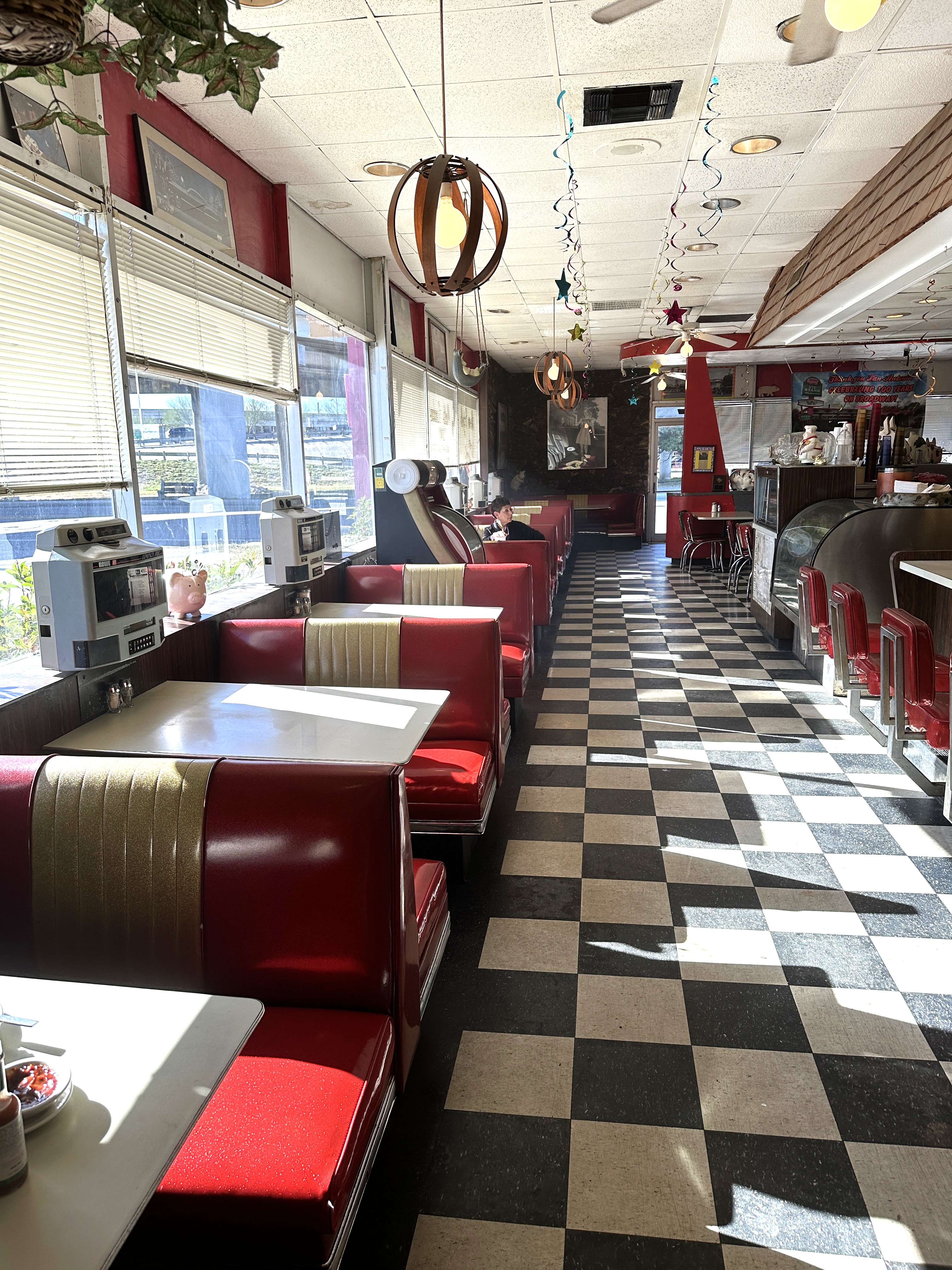
Now, let’s fast forward 102 years. During the meantime, changes in ownership, bad business decisions and non-payment of taxes began a gradual winnowing of the restaurants over the years. Guess how many Pig Stands are left from the original 120 or so?  If you said “none,” you would have matched my guess. But imagine my surprise when Sandy and I, quite by accident, ran across the very last one in operation. It has been there since 1967, near downtown San Antonio, buried underneath an I-10 interchange. It is rather shopworn, and the drive-in part is shut down, home now to a few junky vehicles. As you can tell from the photo, the sign has faded, and the pink art-deco design was out-of-date when the place was built more than 50 years ago. Also gone are the Friday night hot rod gatherings that were all the rage back then.


We had to stop there, of course. Luckily, we hadn’t had lunch, and judging from the rundown look of the place, it had a potential for a death knell itself. We knew this could be our only opportunity ever to patronize a Pig Stand.

To our utter delight, the inside had the same corny décor of many restaurants of the ‘50s and ‘60s. We even gasped when we saw the juke box play selectors at the booths. Could this have gotten any better? And we hadn’t even been seated yet! We were led to a booth by an ancient server in a waitress’ uniform, of all things! I didn’t get her name, as I usually do; my senses were overloaded as it was. Looking over at the juke box selector (I can’t remember if there was a different term for them back when they were popular), I could see that the Beach Boys were still going strong, as were Elvis, Marvin Gaye and Buddy Holly. My nostalgic rush was so strong, I almost didn’t notice when the menus were dropped on our table.


 If you think I would leave there without eating one of their famous pig sandwiches, you would be wrong. That’s what I ordered, and Sandy ordered a hamburger. Having no idea what their classic pig sandwich was like, I was a bit surprised when it arrived. It consisted of thick slices of pork loin and dill pickles between two hamburger buns lathered with barbeque sauce. While it was a decent sandwich, the pork loin was sliced too thick to be tender and, if it had been smoked, it was not really evident. I’m thinking it was just roasted in an oven.


Sandy’s hamburger was declared to be “okay.”

Okay, so the meal wasn’t spectacular. It did not diminish, however, from the feeling I was young again and that Sandy and I were on a date, listening to Bobby Vinton crooning away from the jukebox. I was in heaven.

Looking around, we couldn’t help but notice a vast collection of ceramic pigs in every pose and caricature you could imagine. You can see part of the collection in the photo. I especially liked the pig in a chef’s uniform and the pig on a motorcycle. 


I’m pretty sure all the pigs were for sale because an older couple were standing at the cash register in front, peering into a glass case at a selection of ceramic pigs inside. Our server was there, pointing to the various pigs, most of which appeared to be piggy banks. I overheard her say to the couple while pointing to one of the larger piggy banks, “Now, this one is two hundred dollars.” I was a bit taken aback by this, but I didn’t know if it was a rare artifact or if that was the going price. That’s probably because I have not shopped for any ceramic piggy banks lately.

I guess I’ll recover before long from this blast from the past. I even told Sandy I might try to get a ducktail haircut next time. Always a bastion of support, she said, “Well, you better hurry; that’s about all you’ve got left.”

Oh, the places we go and the places we’ve been. I hope sharing our travels brings back some good memories for you, too.


Thank you, Lord, for this wonderful life; please forgive me if I don't appreciate it as I should every day.


We don't stop playing because we get old; we get old because we stop playing. 
 ---George Bernard Shaw

"I get up every morning, and I just don't let the old man in." ---Clint Eastwood